Exploring Santiago Chile history through places
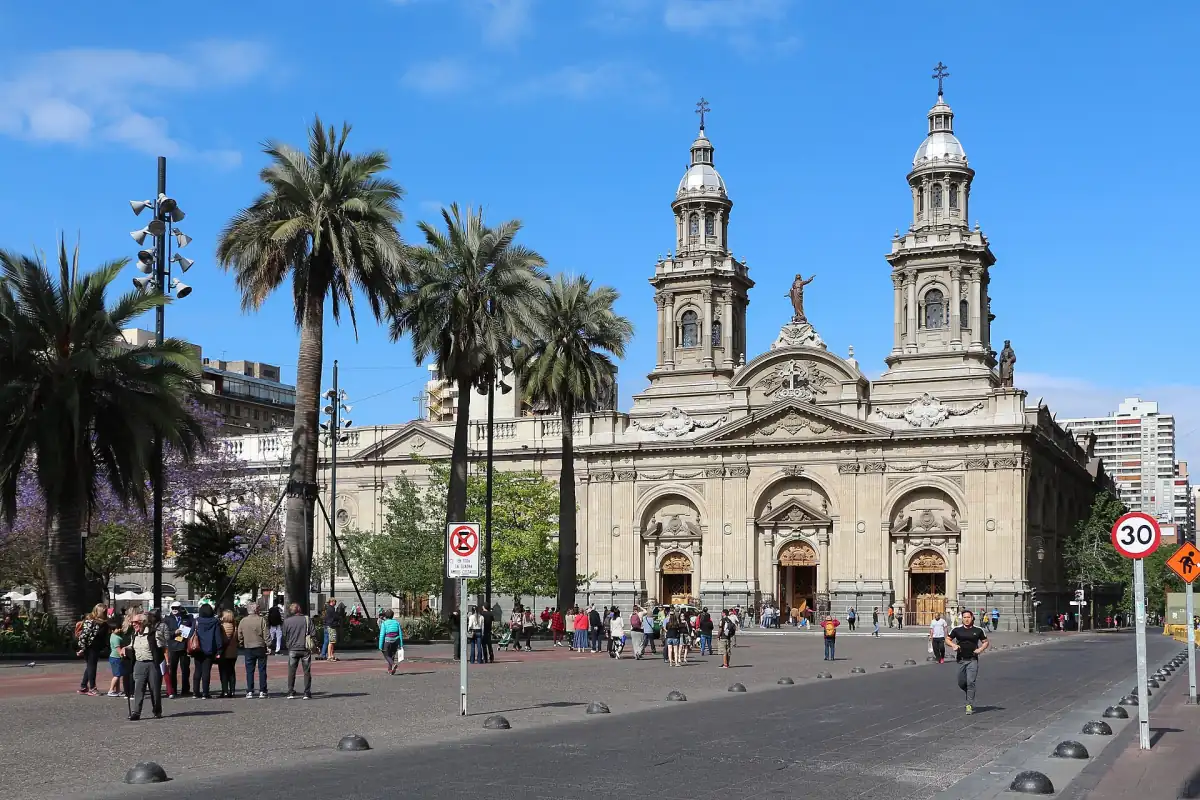
Santiago Chile history offers a clear starting point at Plaza de Armas. Pedro de Valdivia founded the Spanish city on February 12, 1541. The municipal account describes a checkerboard street plan with the square at its political, social and religious centre. Start here to understand the relationship between the central public space, the cathedral and historic administrative buildings, rather than trying to turn a city walk into a complete chronological survey.
Santiago is Chile’s capital beside the Andes. Its historic urban area developed between the Mapocho and the former La Cañada river branch. That setting provides a geographical frame for the central-city visit. Use the sights overview for a wider selection of places and keep this historical day focused on the square, Santa Lucía and a separately arranged palace or hill visit. Each adds a different kind of evidence to the walk.

Plaza de Armas and the city grid
The square is the practical place to begin with the founding plan. Look at the cathedral and administrative buildings in relation to the central space, then consider how the surrounding streets connect with it. The historical point is the square’s role in the plan, rather than a claim that every building visible today belongs to the founding year. Plaza de Armas station serves L3 and L5, making the square a useful transport anchor as well as the historical starting point.
If you prefer a guided city walk, the selected experience includes a professional guide. Its meeting instruction is in front of the National Historical Museum, with a green cap as the identifying detail. Treat the museum frontage as the meeting point; organise museum or palace admission separately. The city tours guide compares other walking and cycling formats if the way you move around matters more than following this independent historical plan.
A guided city walk
Meet a professional guide near Plaza de Armas for a city walk.
Hand-picked tours, booked through Viator. Prices are indicative starting prices in US dollars (as of November 2026). Tap a tour for live availability and the current price in your currency.


Images – Santiago walk with a guide: Cropped from a photo by WeHaKa / CC BY-SA 4.0

Guided walks for a Santiago city visit
A professional guide offers a way to explore the city alongside your own historical sightseeing; palace and museum admissions require separate arrangements.
Huelén and the transformation of Santa Lucía
Cerro Santa Lucía was known as Huelén. Its transformation into a park under Benjamín Vicuña Mackenna began in 1872, and it has been protected as a monument since 1983. These dates describe different stages: the earlier place name, the park transformation and the later protection. Use them to frame your visit without reading every visible feature as part of a single event. Castillo Hidalgo is presented for exterior viewing.
Access needs its own practical plan. Municipal summer hours are Monday 12:00 to 20:30 and Tuesday to Sunday 07:00 to 20:30. Winter hours are Monday 12:00 to 19:30 and Tuesday to Sunday 08:00 to 19:30. The hill closes in rain. Santa Lucía on L1 and Bellas Artes on L5 are the published Metro references. You can combine the area with Lastarria, but leave room to rearrange the outdoor part when conditions change.
Architecture and La Moneda
La Moneda adds an architectural focus to a central-city day. For an interior visit, every visitor aged one or older needs an individual reservation. Minors need an accompanying adult who is also registered. Visitors aged 16 and older must bring an identity document, and arrival is required 15 minutes before the appointment. Choose the palace appointment first if going inside is a priority, then build your independent walk around that fixed time.
Backpacks, bags, suitcases and food are prohibited, and luggage lockers for those items are not provided. Interior video recording is forbidden; photography needs the guide’s permission and must be without flash. Institutional use can require changes to visits or restrict areas. A general city guide service is separate from the palace reservation process. La Moneda station is on L1, while Universidad de Chile connects L1 and L3 for other central-city plans.
The Funicular as a transport monument
The Funicular opened in 1925 and is designated a national historical monument. This gives the San Cristóbal visit a transport-history angle alongside the views. Keep the Funicular distinct from the Teleférico cable car: they have different operating arrangements and ticket conditions. The San Cristóbal guide explains those choices, including the Pío Nono approach. Baquedano on L1 and L5 is the Metro reference for that approach.
For a coherent historical stay, choose between extending the central walk and giving the hill its own time. The museum guide provides another separate cultural option with institution-specific entry rules. It is more useful to leave time for the place that interests you than to assume a city guide, a palace reservation, a museum ticket and a park-railway ticket all form one package. Organise those commitments independently and use the historical dates to connect what you see.
Questions about your visit
When was the Spanish city founded?
Pedro de Valdivia founded Santiago on February 12, 1541. The municipal account describes a checkerboard plan with Plaza de Armas as its political, social and religious centre.
What do the Santa Lucía dates mean?
Huelén is the earlier name of the hill. Transformation into a park began in 1872 under Benjamín Vicuña Mackenna, and monument protection dates from 1983.
Does a city walk arrange a La Moneda visit?
Arrange the palace reservation separately. Each visitor aged one or older needs an individual reservation; minors need a registered adult companion, and visitors aged 16 and older need an identity document.
Why include the Funicular in a history visit?
It opened in 1925 and is a national historical monument. Its transport history adds another theme to an independently planned visit to San Cristóbal.